Sorting Through Fragments of My Mother
August 2, 2022
One of the decisions my mother made before she died—one I continue to find admirable—was to landscape the western side of our corner house in St Louis. The house was made of brick and had an overgrown strip of land that faced the side street. When I was growing up, I’d nicknamed that area “the bear cave,” because I imagined that wild bears lived there.
Years later, the chaos of dead trees and unkempt shrubs was finally cleared away. My mother chose four hemlocks for the men to plant near the road, interspersed with some pastel-colored perennial flowers and hardy pink rose bushes, and she had a row of soft ferns planted closer in toward the house. She also picked out an array of smooth, irregularly shaped stepping-stones, which were laid along the inner edge of the ferncover so that she could walk outside next to her garden. Many afternoons, I would come home from my part-time work to see her there, lumbering up and down the length of her plot, or leaning on her Peruvian bird’s-head cane and examining the flowers beneath the trees, the unfurled scrolls of the ferns.
She liked looking out at her botanical arrangement from the two windows that faced west from her master bedroom on the second floor. When it was too hot for my mother to go outside, or when she was too sick, or too angry, she still spent long minutes gazing out at the garden from her room, feeling satisfied that something she put in the earth—something whose planting she had overseen, anyway—was blooming.
I had been precocious and exceedingly well-behaved when I was younger - a stellar student, an enthusiastic and somewhat talented violinist, and a sure-footed writer. At 6 or 7, I was writing comic epitaphs on the back of paper placemats whenever we went out to eat. (“Here lies the body of Mr. Holt, / struck one day by a lightning bolt.”)
My mother’s role, so it seemed to me, was to shuttle me to violin lessons, and ballet lessons, and summer camp for the gifted, and, of course, school when it was her turn to drive carpool. She read my report cards and took notes at my violin lessons so she could remind me what to practice before I could remember for myself. She bought me nice clothes, even occasionally fancy dresses from chic department stores. She made me pancakes on weekends. She did everything a dedicated middle-class mother in the Midwest of the late twentieth century was expected to do. Yet I never felt she was satisfied. Like most children do, I assumed that I was responsible for my mother's happiness and therefore had to keep doing better and better at school, violin, anything I set my hand to.
I recently watched a clip of an old dance class of mine. A family friend had given me a compact disk he’d made from the original video. I was 7 or 8 in the recording. When I played the clip on my laptop, I was surprised to see my mother appear in the studio’s wall of mirrors, her head tilting slightly to one side, her arms akimbo. She was sitting a few chairs down from this friend with his video recorder, one of a small group of parents watching the rehearsal.
She didn’t seem to be smiling, though she didn't frown outright. A deeply buried self-consciousness welled up in me as I sat watching the video, and the impatient question: What was she doing there? I imagined I must have been trying to keep it all together for her—stay on the beat, keep my posture straight. In one camera shot, I’m watching myself in the mirror, looking rather defeated and miserable as I hold my hands together in the shape of an egg. I dip and rise, dip and rise, trying to keep the egg’s imaginary shell intact.
One afternoon at the music conservatory, a few years later, my mother joked to a friend’s mother, “I feel so poor!”
We were in the hall, coming to or going from a violin lesson or perhaps a concert. I was standing a few feet away and heard every word. I felt myself flush and tightened my grip on the violin case in my hand. I knew we weren’t poor, because my father ran his own biofeedback practice and my mother worked full-time as well, and they both wore good clothes, and they had money for all our good clothes, for my violin, for a thousand other things, some of which I didn’t even know. So I dismissed what she said as an odd joke, even as I sensed the discomfort she was feeling and trying to ignore through this outward deflection.
She likely had to carefully budget for all these things for me and hadn’t much time or money left for herself. But the day when she could show herself some attention never arrived. She was just forty when my father’s first cancer diagnosis came. And after it went into remission, less than a year elapsed before my mother’s own cancer diagnosis. After it went into remission, my father’s second cancer diagnosis and his decline and death rapidly followed—all in the span of 5 years.
As it turned out, I couldn’t keep things together for my mother. I couldn’t save her.
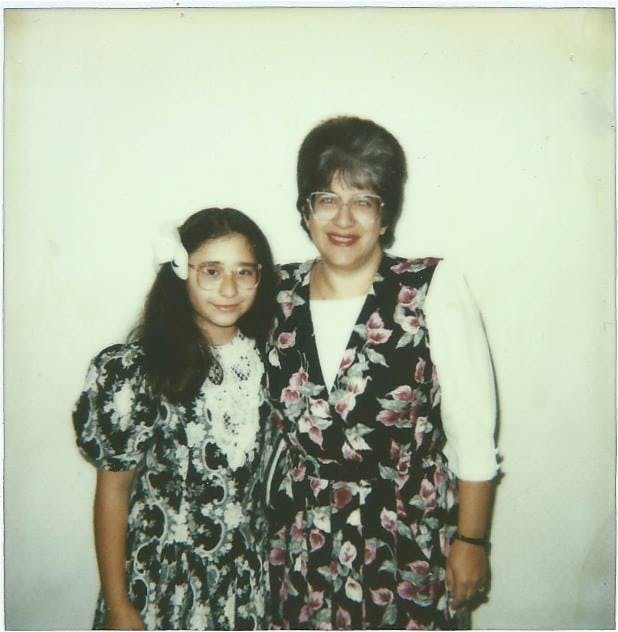
Jenn with her mother
When I was 26, and a year had passed since my mother’s death, I could wait no longer and needed to clean out her closet in the back room upstairs. Besides the double closet, the second floor addition housed an old bed that I’d used for guests at middle school sleepovers, as well as the family desktop computer—a Compaq that had outlived my parents.
The portable hospital bed in the downstairs spare room had been removed soon after my mother had passed away. The partially used bottles of toiletries had all been disposed of. The nurses and aides, their papers filed away, had moved on to other home health care patients. Hospice, though, was still sending me mailings with their suggestions for self-care, for ways of remembering my “loved one.” Ha, I wrote long-hand in my journal, how could I possibly forget her? My task, as I understood it at that time, was to sort through and organize all my images of my mother: sick, well, or at least in remission; coiffed, bald, or bewigged; angry, expectant, scared. How tenaciously, how lightly, ought I to hold her in memory?
I wondered. I was concerned about how to do this thing called grieving “the right way,” and, I suppose, was interested in choosing wisely, as if it were something I had control over. Yet the way that memory takes hold doesn’t seem so much like a choice; it seems like a haunting. I needed to find the right spell, the spell that would turn the angry ghost into a crone, the crone back into a maiden.
My younger brother Benjamin was home from Knox College in Illinois, where he had just finished his freshman year. I took advantage of his presence at the tail end of his summer vacation to wrangle him into helping me clean out the spare bedroom upstairs. It was situated directly above the room in which my mother had died that past September, just before dawn. This spare room had been the place my mother stored the things she saved, things she didn’t want to donate or toss, not yet—not until after her death, it turned out, when it wasn’t something she would need to decide. That task was left to Ben and me, because our father Ken had died a decade earlier—also of metastatic cancer. How does that joke by Oscar Wilde go? “To lose one parent may be regarded as a misfortune; to lose both looks like carelessness.”
I wasn’t laughing.